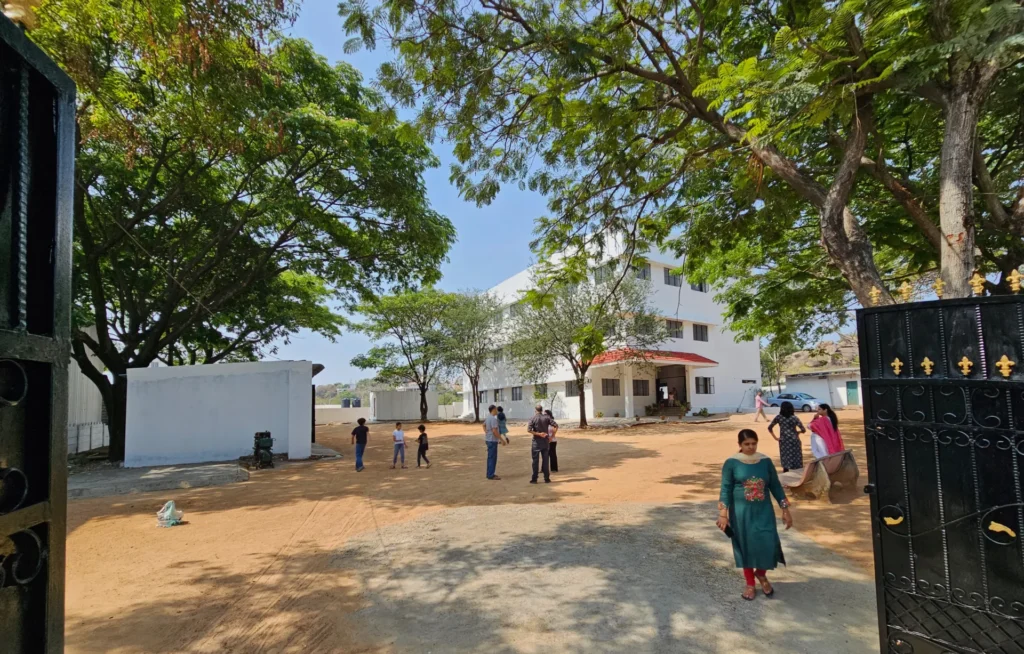
I have been documenting alternative learning spaces for the last 8 years, and with every documentation I am gaining the confidence that students in alternative schools are active conscious learners who are in the practice of using higher cognitive functions on a daily basis. I arrived at this gradually, through countless conversations, observations, and moments when I witnessed learners engage with the world not as passive recipients of information, but as thinking, questioning, and contributing members of their communities. Sunnyside Experiential Learning School in Chennai, led by the founder-principal Sabina Fathima Sirajudeen, represents one of the most compelling examples of this transformation I have encountered.
A Conversation with Fathima: Understanding the Philosophy Behind the Space
When conversing with Fathima, what struck me most was not just her critique of the conventional schooling system, but her unwavering conviction that learning must be rooted in human experience and self-directed exploration. She spoke candidly about her own schooling, how excellence in mathematics entitled you to leadership roles regardless of your actual capabilities for leading, how questioning was discouraged, and how childhood became a casualty of the race for scores.

Her journey to founding Sunnyside is deeply personal. When her own son couldn’t settle into traditional schooling, when he fell sick under the pressure, when doctors simply advised “changing schools,” Fathima found herself searching for an alternative. She discovered Montessori education and witnessed something transformative: children who were happy, whose childhoods weren’t sacrificed on the altar of achievement. But when the pandemic closed that school and she looked for similar alternatives for high school, she found a void. Either schools abandoned academics entirely, or they returned to the conventional pathway. There was no middle ground, no space that honoured both meaningful academics and the fuller development of the child.
So she did what many frustrated parents dream of but few execute: she started Sunnyside at home with just eight children in 2022, driven by a mother’s need rather than an institutional blueprint. Today, it houses 30 students across multiple grade levels, growing entirely through word of mouth.
The pedagogy Fathima articulates is built on two pillars: experiential learning and self-direction. The first stems from a simple but profound observation, whatever we experience stays with us for life. She described family travels where children, with no agenda of “learning,” would pick up knowledge organically, ask questions, and pursue curiosities. This real-world, hands-on engagement, she realised, creates knowledge that textbooks cannot. The second pillar, self-direction, challenges the traditional school structure where someone else directs every step of a child’s learning, robbing them of ownership. At Sunnyside, self-direction is a disposition that must be developed from younger years, the practice of doing things independently, making choices, and living with consequences.
What impressed me most was her answer when I asked about outcomes: ‘The whole focus is actually not on the outcome for the school, it’s the process. In this process, the kind of people they become.’ This is not soft pedagogy masquerading as rigor. This is clarity about what education fundamentally should do.
To truly understand how deeply experiential learning runs through Sunnyside, I spoke with students themselves. What emerged was not enthusiasm for “fun learning,” but genuine intellectual engagement with real-world problems.

The ecosystem explorers — Jashwanthi, Hanah, and Huzaifah
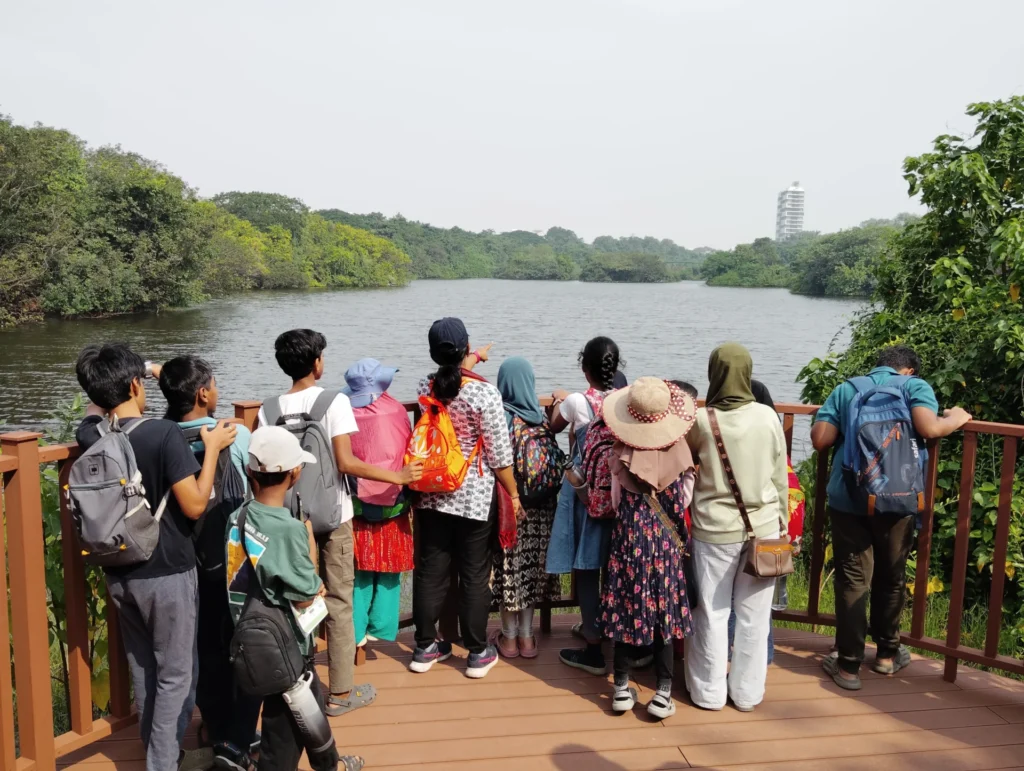
I sat with three middle schoolers — Jashwanthi, Hanah, and Huzaifah, who shared about their Multi-Disciplinary Project (MDP). Their project began two years ago with an exploration of their local ecosystem, and they have now evolved into studying mangroves, coral reefs, and blue carbon ecosystems. What fascinated me was how they described the progression, it wasn’t imposed from above but organically deepened. They started by experiencing their environment, and their curiosity has carried them through months of investigation into increasingly complex ecological concepts.
The idea of making learning more experiential has always been credited over traditional learning, and there are sound reasons for this. Children grow up in different environments with different learning styles, different paces, different interests. Restricting them to one way of seeing the world is the biggest failure of our education system. What Sunnyside demonstrates is that when you start with experience, real observation, real questioning, the theoretical frameworks they encounter in books become tools for understanding rather than abstract concepts to memorise.
More than anything else, the Indian education system needs quick policy integration and region-based policy adaptation. A one-size-fits-all approach ignores the diversity of how children learn and what they need to thrive.
Climate change through the eyes of a young researcher — Abdul Musawwir’s journey
Abdul Musawwir, age 14, shared his journey of exploring climate change which started 3 years back while exploring local waste management which then moved on to exploring the science behind climate change and so on. What struck me most was that this wasn’t a school project assigned with a deadline. His subject was to study the effect of climate change on fishermen, and he went out and interviewed them directly and also talked to experts working to combat climate change and authoring books based on the same. He didn’t learn about climate change in the abstract; he learned it through the lived experiences of people whose livelihoods depend on understanding atmospheric and oceanic patterns. Abdul also studied the changing local landscape and missing waterbodies of the area in which the school is located and its connection to climate change and further created projects on implementable solutions.

What I observed consistently across Sunnyside is that students use pen and paper to document their observations. In an age of digital devices, this might seem anachronistic, but it’s profoundly purposeful. This practice connects their bodies to their learning and experiences, there is a tactile, embodied quality to knowledge-making that digital note-taking often lacks. This is what holistic education looks like in practice.
Even Mahatma Gandhi in his approach to Nai Talim mentioned : “By education I mean all-round drawing out of the best in a child’s body, mind and spirit.”
Every act of documentation by the students at Sunnyside school, every field visit, every interview is an expression of this holistic vision.

When I asked Abdul to explain PBL (Project-Based Learning), his response was illuminating. “It’s a part of our bigger idea of experiential learning, which initially starts with local enquiry and then goes on for months and sometimes years of search for answers, which then turns into projects.” This is not project-based learning as it’s often commercialised, a neat six-week unit with a polished presentation. This is an extended, sustained inquiry that begins with experience, deepens through research, and connects to theory.
The methodology is elegantly simple. Students go out into the field, experience something directly, document their observations, and then come back and relate their experiences with theories from their books. This is how they study science and mathematics, not as abstract symbol systems, but as languages for understanding the world they’ve already begun to explore. This reversal of the traditional sequence, experience first, then theory adds immeasurably to the nature of education Sunnyside advocates.

What moved me most was how students approach their findings. When I asked Abdul what he would do with his reports and documentation, he mentioned that he plans to submit them to the Greater Chennai Corporation. This is the moment when education transforms from academic exercise to civic engagement. These students are not only working on problems; they have ideas on how to solve them and are taking steps to implement those solutions.
This is evident in how Fathima described the high schoolers’ climate resilience project. Over three years, they studied climate change in their locality, met with stakeholders (fishermen, sanitation workers, delivery personnel), empathised with their struggles in heat, and came up with concrete solutions: redesigned houses for heat resilience, improved sanitary kits for women workers, climate-resistant playgrounds. They didn’t stop at analysis. They created reports to submit to municipal authorities, transforming their learning into actionable policy recommendations
When I raised the natural question, how is this different approach helping students compared to traditional pathways? Fathima’s response was rooted in a fundamental belief: “Children are never taken seriously. We don’t think that they can contribute to society in any way at all.” Yet at Sunnyside, students routinely do what adults in conventional settings might hesitate to attempt: they propose solutions, create prototypes, and seek to influence policy.
Fathima noted that self-awareness, knowing what you want, discovering your calling, finding joy in what you do is something she lacked in her own education. It took decades for her to arrive at her purpose. At Sunnyside, children develop this through practice, through being taken seriously as thinkers and contributors. The real outcomes, she emphasized, might not be visible until these students are in their 30s and 40s, living lives of purpose rather than enduring them out of habit.

The school does maintain academic rigor. Students currently take the Grade 10 and 12 exams through NIOS, earning standard certifications. But these exams are positioned as a necessary pause in the year, not the organising principle of education. The three batches of graduates who have already moved on to university have, according to Fathima, “done very well, scoring marks in their 80s and 90s.”
Talking with Fathima and her students, I was reminded of something I’ve observed across eight years of documenting alternative spaces: the most powerful learning happens when students are trusted with real problems, given time to explore deeply, and invited to contribute meaningfully to their communities.
Sabina Fathima Sirajudeen has created a space where this is not an exception but the daily practice. In a country where education policy often moves at glacial pace, where standardisation is mistaken for quality, and where childhood is bartered for test scores, Sunnyside stands as both critique and alternative. It proves that when we shift from asking “What can we teach?” to asking “What do learners need to become conscious, capable contributors to their world?” everything changes.

The students I met, documenting ecosystems, interviewing fishermen, redesigning uniforms, proposing policy solutions are not exceptions. They are what becomes possible when we honor the full humanity of young people, trust their capacity to think and act, and create structures that support sustained, experiential engagement with the world. This is not soft pedagogy. This is, perhaps, the most rigorous education possible, one that demands critical thinking, creative problem-solving, empathy, and the courage to act.
As I continue documenting alternative learning spaces, I do so with growing conviction: the future of education belongs not to those who can memorise most efficiently, but to those who can think most clearly, question most persistently, and contribute most meaningfully.
Here are some of the reports generated by the school students,
1. Mapping and Analysis of Playgrounds in the Palavakkam Vicinity — Click to view
2. Redesigning Protective Clothing for Sanitary workers — Click to view
3. Sanitation and Infrastructure Improvement Proposal for the Palavakkam Fish Market, Chennai — Click to view
4. Sustainable Sanitary Kit For Conservancy Workers — Click to view
To explore Sunnyside School we encourage you to connect with the school directly at www.sunnysidelearning.org
This above article is based on two separate online interview sessions conducted in July 2026: the first on July 21, 2026, with Sabina Fathima Sirajudeen, Principal and Founder of Sunnyside Experiential Learning School, Chennai, covering the school’s philosophy, pedagogical approach, and the founder’s vision; and the second on July 27, 2026, with current students including Jashwanthi, Hanah, Huzaifah (middle school), and Abdul Musawwir (junior high school), focusing on their experiences with experiential and project-based learning. The views, observations, and statements presented in this article are based solely on these two interview sessions and do not represent independent verification, external assessment, or comparative analysis with other educational institutions. The article reflects the perspectives and experiences shared by the interviewees during these sessions.